
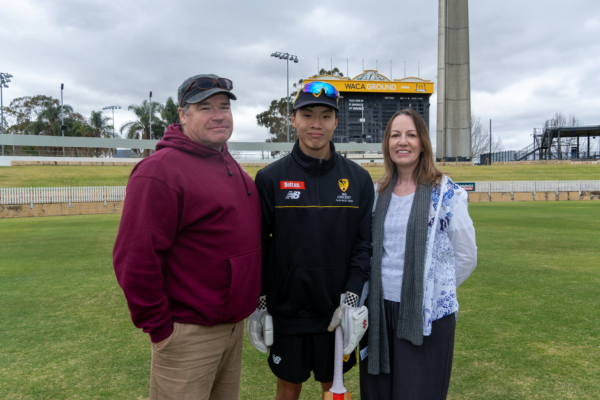
Eligh with dad Kaine and mum Emma at the WACA Ground.
Eligh Frunks was three months premature, and for the first years of his life, he barely walked. Carried everywhere by his foster family in Taiwan, he’d never felt grass under his feet.
When he arrived in Broome, having just turned four, newly adopted alongside his brother Noah, his parents Kaine and Emma put him down on the lawn in the backyard, and he screamed. It took weeks before he’d tolerate it.
Today, a few months before his 17th birthday, Eligh is a wicketkeeper, batter and bowler for WA’s Intellectual Disability cricket team, a coach to primary school kids, and a young man who, by his father’s own admission, can’t walk into a cricket ground without bumping into someone he knows within two minutes. “Mr Cricket,” Kaine calls him.
It’s a long way from where the family started.
The adoption process took the best part of 10 years from application to approval, then another 12 months before Kaine and Emma could travel to bring the boys home. Eligh and Noah didn’t know each other; they’d grown up in separate foster homes, and neither spoke English.
What they were given instead was time: months of video calls, photo albums and toys sent ahead, flash cards in Mandarin and English taped up around a new house in a new country. It was, as Emma puts it, everything, and a lot for them.
Cricket found Eligh almost by accident, the way it finds a lot of kids who grow up in the regions: in the backyard, then at the local oval, then through junior Blast programs. But what he lacked, for a long time, wasn’t a sport. It was a sense of purpose within one.
That changed when the family found the WA Cricket Foundation’s disability pathway programs. Eligh remembers being nervous walking into his first trial.
“I knew once I got into the team, I’d be comfortable with the coaches and players,” he said. “I’ve made new connections with the coaches and team, and that’s been amazing for me because I like making new friends and connecting.”
Emma describes the change since as exponential. It’s created a real sense of belonging, she says; before this, he was loving cricket but had a lot of highs and lows, and was very hard on himself.
Within the first six months of joining the program, Eligh was also diagnosed with autism, but where that diagnosis might have been an isolating moment for many families, for Eligh it barely registered as one. His teammates, including one of his closest mates in the side, Alex, were on the same journey. He just felt like everyone else, Kaine says.
That acceptance, Emma believes, unlocked everything that followed. “There was a level of acceptance, a level of belonging, a level of ‘I am important’, and a level of leadership; it just gave him that drive and confidence to keep going,” she said.
For Emma, the program’s impact has gone well beyond the game itself.
“Participation in the WA Cricket Foundation’s Inclusion Cricket Program has been life-changing for Eligh, providing far more than the opportunity to play cricket,” she says.
“Being surrounded by peers, coaches, and volunteers who understand and embrace individual differences has helped Eligh develop a positive acceptance of his own challenges, while fostering open and meaningful conversations about disability and inclusion. Through these experiences, he has built friendships, developed resilience, and gained the confidence to participate more fully both on and off the field.”
“For Eligh,” she says, “this program represents not only inclusion in sport, but also hope, opportunity, and a pathway to achieving his full potential.”
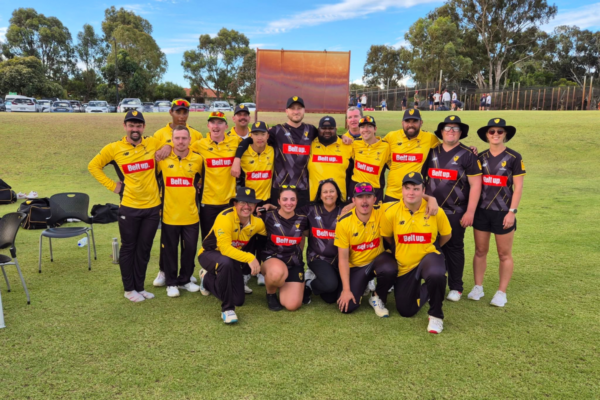
Eligh and his WA Intellectual Disability Side at the 2026 National Cricket Inclusion Championships.
It’s confidence that carried him into a SEDA cricket schooling program, a scholarship with the Peel Regional Academy of Sport, senior cricket at Halls Head Cricket Club including umpiring and scoring, and a work experience role in coaching at Evolution Cricket, Golden Bay, under Brendon Diamanti, whom Eligh credits with teaching him “how he coaches and how he develops his players.”
One moment stands apart from the week-to-week programs: turning out for the Governor’s XI against the Lord’s Taverners XI at the WACA Ground. It was his first time playing at the historic ground, and by his own account, nerves swiftly gave way to enjoyment as he relished in the environment.
The exhibition match was a highlight, but it’s the ongoing programs Eligh trains in regularly that have made the lasting difference, and that access remains rare. Fewer than one in twenty cricket clubs across WA currently run programs equipped to include players like Eligh.
For a family that spent years searching for the right fit, that scarcity is not lost on them.
“We’re just rapt that we found it,” Kaine says.
“Ideally, there would be more programs like this available across the community. However, having this opportunity is invaluable, and it should be fully supported and utilised.
“It has played an important role in raising awareness of inclusion within cricket, encouraging meaningful conversations about accessibility and creating greater acceptance of people with disabilities at the local club level.”
Ask Kaine what life would look like without it, and there’s no hesitation.
“It would be completely different. I think Eligh’s transition into adulthood, he might’ve been a little bit lost if he didn’t have a lane to fit in, because we hadn’t found it yet.”
He has found it now. Eligh recently performed well for WA’s Intellectual Disability side at the 2026 National Cricket Inclusion Championships in Perth, and has just returned to pre-season training as he looks to build on that campaign.
Beyond that, his ambitions are refreshingly uncomplicated.
“My goal is to play for Australia,” he says. “And if other people haven’t found this pathway, I just want to say, give it a go and see where it takes you. If it’s not for you, then it’s not for you. As long as you have a go, that’s the main thing.”
It’s advice his parents hope reaches families who, like theirs once did, are still searching for their own lane.
“There are plenty more families like us out there looking to find their lane,” Kaine says. “If they can find their avenue through sport and cricket, that’s fantastic. It’s just so rewarding.”