
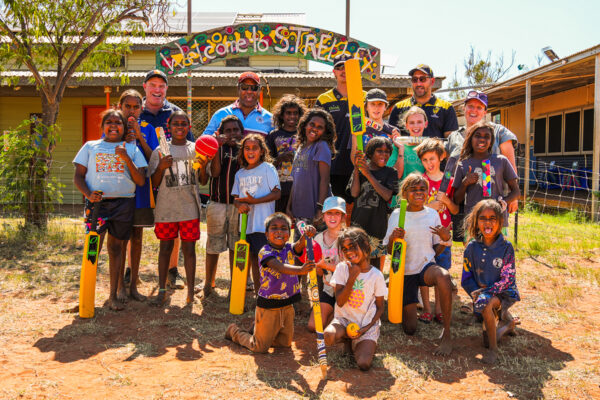
For most of the year, sport at Strelley Community School means footy. The ball comes out at recess, at lunch, after school, on the vast red dirt of the Pilbara that has always belonged to the Nyamal people. Cricket, until recently, had never really been part of the picture.
That changed in May, when the WA Cricket Foundation travelled to the school’s two remote campuses, Strelley and Warralong, delivering clinics to kids who, for many, were holding a bat for the first time in their lives.
“It’s really, really important that the kids get to experience different types of sports,” the school’s principal, Rutu Were says.
“They’re quite familiar with footy, and this is the first time I’ve seen cricket come into our school, so that’s really exciting.”
For a community where English is a second language for most students, cricket offered something rare: a shared activity that needed no translation.
“It has no boundaries in terms of age,” Rutu says. “Everyone can play, so they can bring in the parents, uncles, or even their little ones and play.”
It’s a new skill, too – from holding the bat properly to the basics of running between the wickets – and one the kids can carry home into their own communities long after the Foundation has left.
That continuity matters more than most visiting programs can offer, largely thanks to the equipment left behind.
“Without those resources from the WA Cricket Foundation, they may enjoy the sport but wouldn’t be able to continue it,” Rutu says.
With bats and balls now part of the school’s own kit, cricket has earned a permanent place in the curriculum. We’ll implement it into our sports curriculum, for sure.”
The clearest measure of that impact came four months earlier, in December, when two of the school’s students travelled to Perth for the Kambarang Cricket Carnival at the WACA Ground.
For kids growing up on sunburnt red dirt hours from the nearest town, it was a journey into an entirely different world: their first flight, their first taste of plane food, their first glimpse of the ground where elite cricket is played.
An 11-year-old girl from Strelley remembers being interviewed on the WACA Ground for a feature video.
“We played cricket, and spoke on the microphone on the oval,” she says, moments after breaking into a grin recalling the memory of a flight that was, at the time, a little frightening.
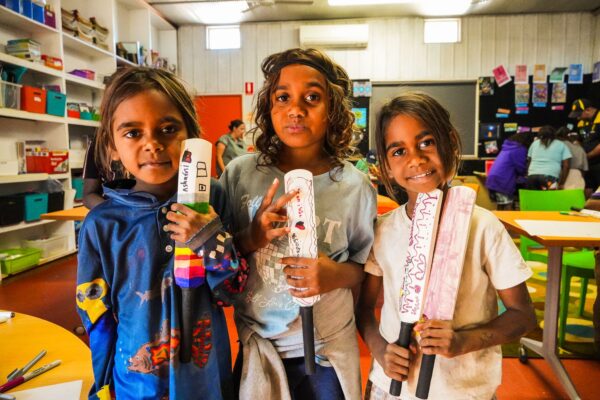
Back home, she proudly showed how her phone took photos, capturing the iron-rich soil, native bush and smiling, bare-footed youths, alongside newly painted cricket bats decorated in traditional style. “We were making cricket bats, good ones,” she says.
For Gavin McMeekin, an Indigenous Sports Development Officer with Ngurra Kujungka who works alongside the Foundation to deliver its remote programs, the annual trip to Perth is as much about connection as it is about cricket.
“Kambarang was a lot of fun, and a really well-run carnival,” he says.
“Kids from these communities don’t often get to come down to Perth, so when they do, they’re absolutely stoked. They get to meet other kids from town and make new friends, and when they come back to the community they say, ‘we made a new friend.'”
That connection runs both ways. McMeekin has been visiting Strelley and Warralong for years, and the kids remember him as much as he remembers them.
“Even yesterday, they were asking me if I remembered the first time I met them a year and a half ago,” he says. “They can’t wait for you to come back to the community to make sure you remembered them.”
For a community where footy has always been the default, cricket’s arrival hasn’t displaced anything. It’s simply given kids another option at lunchtime, another reason to bring family together on the oval, and for two students in particular, another reason to get on a plane and see what else is out there.
“The more sport and programs you can get out to communities, the better,” McMeekin says.
“It adds massive value to these communities, without question, especially seeing as it’s such an inclusive sport.”